|
The months for the pilgrimage are well
known. The four sacred months, viz.
Rajab(7th), Zul Qadah (11th), Zul Hijjah
(12th, the month of Pilgrimage), and Muharram
(1st). Excepting Rajab the other three months are
consecutive. In all these months war was prohibited. That is
to say, the first rites may begin as early as the beginning of
Shawwal, with a definite approach to Makkah but the chief
rites are concentrated on the first ten days of Zul Hijja, and
especially on the 8th, 9th and
10th of that month, when the concourse
of pilgrims
reaches its height.
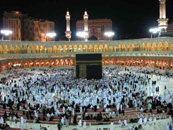
The chief rites may be briefly enumerated:
(1) the wearing of the ihram from Meeqat fixed definitely on
all the routes to Makkah. After this the pilgrimage
prohibitions come into operation and the pilgrim is dedicated
to worship and prayer and the denial of vanities;
(2) the
going round the Ka’ba seven times (tawaf), typifying activity,
with the kissing of the little Black Stone built into the
wall, the symbol of concentration in the love of Allah;
(3)
after a short prayer at the Station of Abraham, the pilgrim
visits what may be called as station of Ismail (the fountain
of zam zam) followed by running between the hills of Safa and
Marwah, the symbol of patience and perseverance; the
running between the two hills has both spiritual and moral
dimensions.
(4) the great Sermon (Khutba) on the
7th of Zul Hijja; on 8th Zul
Hijjah, the whole body of pilgrims moves to the Valley of Mina
(about six miles north of Makkah, where the pilgrims halt and
stay the night; on 9th they proceed to the plain
and hill of ‘Arafat, which is also called the Mount of Mercy
(Jabl-e-Rahama) about five miles further north,;
(5)
the tenth day, Yaum Nahr, the day of Sacrifice, when
the sacrifice is offered in the Valley of Mina, the head is
shaved or the hair trimmed, the symbolic ceremony of casting
seven pebbles at the Jamarat is performed on the first
occasion and the Tawaf al-lfada or circumambulation of the
Ka’ba is undertaken: the Rami is continued on
subsequent days, both rites are connected with the story of
Abraham. This is the ‘Id-ul-Adha’, the ceremony is
connected with the rejection of evil in thought, word, and
deed. A stay of two or three days after this is prescribed:
these three days are called Tashriq days. The Appointed Days:
the three days after the tenth, when the pilgrims stay on in
the Valley of Mina for prayer and praise. It is optional for
pilgrims to leave on the second or third
|